
Custom Development
Alcohol Delivery Market Share and Trends: Size, Growth, & Business Opportunities
7 Apr 2026
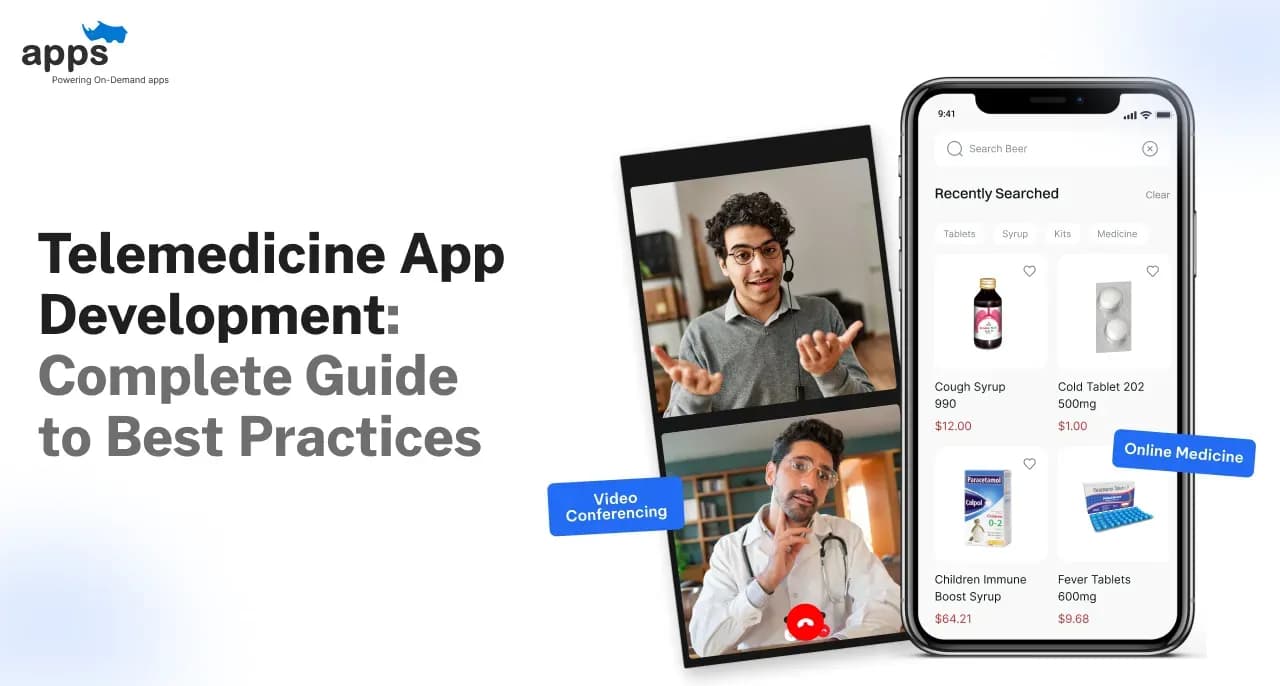
The healthcare industry is shifting fast, making telemedicine app development a must for hospitals, clinics, and doctors. Patients now expect seamless, secure remote consultations, but building a custom telemedicine app comes with challenges—compliance, security, and user experience.
Many providers struggle with choosing the right platform and developer, risking functionality issues and scalability concerns. Without expert guidance, navigating custom telemedicine app development can be overwhelming.
This guide breaks down the essentials—key benefits, challenges, and best practices—to help you make informed decisions and build a telemedicine solution that meets both patient expectations and industry standards.
The telemedicine market is experiencing significant growth, indicating strong support for developing custom telemedicine apps.
These trends show the growing demand and market potential for custom telemedicine app development.
Developing a custom telemedicine application requires incorporating essential features to ensure functionality and user satisfaction according to the nature of your healthcare practice and patient base.
The perfect application is a myth. All are work in progress. To get started quickly, you can launch a viable version of the product with the most essential features.
Tailoring features to the specific needs of your practice ensures a more effective telemedicine solution
The healthcare industry is evolving rapidly, but many business owners face significant challenges in delivering efficient and accessible care.
Custom Telemedicine apps have emerged as a transformative solution, addressing critical pain points and revolutionizing patient care.
Below, we explore the key challenges healthcare providers face and how telemedicine apps can effectively resolve them.
Healthcare providers often struggle to reach patients beyond their immediate geographic location, limiting their growth potential.
For instance, a clinic in an urban area may not attract patients from rural regions due to distance barriers.
A telemedicine app eliminates these constraints by enabling virtual consultations, allowing providers to connect with patients nationwide or even globally.
This not only increases the patient base but also enhances revenue streams without the need for physical expansion.
Managing patient records manually or through outdated systems often leads to errors, misdiagnoses, and inefficiencies.
For example, a patient’s medical history might be scattered across multiple systems, making it difficult for doctors to access comprehensive data during consultations.
As patient numbers grow, healthcare providers often face challenges in responding to queries promptly. This can lead to patient dissatisfaction and missed opportunities for timely care.
For example, a busy clinic might take days to respond to appointment requests or follow-up questions.
Many healthcare providers use multiple systems for billing, diagnostics, and patient management, leading to fragmented data.
This lack of integration can result in inefficiencies and errors, such as duplicate tests or missed follow-ups.
Rural areas often lack access to quality healthcare facilities, forcing patients to travel long distances for medical care. This not only increases costs but also delays treatment, especially for chronic conditions.
In emergencies, timely medical intervention can be life-saving. However, many patients, especially in remote areas, struggle to access immediate care due to distance or lack of nearby facilities.
In regions with inadequate transportation or communication networks, accessing healthcare can be a significant challenge. Patients may miss appointments or delay seeking care due to these barriers.
Building a telemedicine app requires a structured approach to ensure security, compliance, and user satisfaction.
These six steps will help you develop a custom telemedicine app that efficiently meets patient and provider needs.
Choosing the right platform is critical to the success of your telemedicine app. Your decision will affect user accessibility, development costs, and long-term scalability.
So, before you go ahead, ask yourself these questions:
If most of your patients use smartphones, then a mobile app (iOS, Android) is ideal.
If your business also caters to doctors who prefer desktop access, a web-based platform may be necessary.
Native apps (Android/iOS): Offer better performance and stability but take longer to develop.
Cross-platform apps (Flutter, React Native): Faster development, but may have performance limitations.
Cloud-based apps allow for remote accessibility and easy scalability.
On-premise solutions give you full control over data security but require higher infrastructure costs.
💡 Solution: Work with experienced telemedicine app developers who can help you evaluate the best platform based on your business needs and budget.
A telemedicine app should prioritize user experience (UX). If patients struggle to navigate the app or doctors find it cumbersome, the adoption rate will be low.
✔ Easy Navigation & Clean UI: Patients should be able to book appointments in a few taps, and doctors should access patient data effortlessly.
✔ Accessibility Features: Large fonts, voice commands, and multi-language support for diverse user needs.
✔ Secure Login & Data Encryption: Ensuring patient confidentiality with HIPAA-compliant authentication methods like two-factor authentication (2FA).
✔ Responsive Design: Ensuring the app works seamlessly across devices—smartphones, tablets, and desktops.
💡 Solution: Hire a UI/UX designer with healthcare experience to create an intuitive and accessible telemedicine app interface.
A telemedicine app requires multiple third-party API integrations to offer key functionalities like video calling, payments, and patient records.
💡 Solution: Your telemedicine app developer should recommend the right APIs based on your app’s needs, ensuring seamless functionality without security risks.
After designing and integrating APIs, the actual development phase begins. This step involves coding the app’s frontend and backend while ensuring it’s scalable, secure, and high-performing.
✔ Real-Time Communication: Enabling video and voice calls between patients and doctors.
✔ Appointment Scheduling: Letting patients book, reschedule, and cancel appointments effortlessly.
✔ Automated Reminders: Sending SMS/email reminders for appointments and prescriptions.
✔ Secure Patient Data Storage: Encrypting all health records to comply with HIPAA and GDPR regulations.
✔ Multi-User Roles: Assigning permissions for doctors, patients, and admin staff to access relevant data.
💡 Solution: Ensure that your development team follows best coding practices for a stable, bug-free, and secure app.
Before launching, your telemedicine app must be thoroughly tested to avoid bugs, security breaches, and performance issues.
💡 Solution: Skipping testing can result in compliance violations and user dissatisfaction. Work with developers who offer detailed QA and security testing.
Once testing is complete, your telemedicine app is ready for launch. However, the work doesn’t stop here—ongoing maintenance is crucial for smooth performance.
📌 Deployment to App Stores & Web: Ensuring approval for Google Play Store, Apple App Store, and Web.
📌 Performance Monitoring: Tracking app speed, uptime, and error logs.
📌 User Feedback Collection: Addressing user complaints and improving the app experience.
📌 Regular Updates: Releasing bug fixes, security patches, and feature upgrades.
📌 Scalability Planning: Preparing for increased user demand as your healthcare business grows.
💡 Solution: Work with a development team that offers post-launch support for regular maintenance, feature updates, and security enhancements.
Developing a telemedicine app requires careful financial planning. Whether you run a small clinic or a large hospital, understanding the cost factors can help you make informed decisions and avoid unexpected expenses.
Several elements affect the overall cost of building a telemedicine app, including:
App Complexity and Features – A basic app with video consultations will cost less than a fully integrated platform with AI-powered features, EHR connectivity, and e-prescriptions.
Platform Choice – Developing for iOS, Android, or both will impact costs. A web-based solution can be more affordable but may have limitations.
Third-Party Integrations – APIs for video calls, payment gateways, and medical record access add to the budget.
Security and Compliance – Implementing HIPAA, GDPR, and data encryption measures requires additional investment.
Development Team – Hiring an experienced Telemedicine App Developer or outsourcing to an agency will have different cost implications.
Small Clinics & Startups – A basic telemedicine app with essential features (video calls, appointment booking, and messaging) typically costs $30,000 – $70,000.
Mid-Sized Healthcare Businesses – A more advanced app with EHR integration, AI recommendations, and multiple user roles may cost $80,000 – $150,000.
Large Hospitals & Enterprises – A fully customized platform with AI, remote patient monitoring, blockchain security, and multi-platform compatibility can range from $200,000 – $500,000.
For smaller healthcare businesses looking to build a telemedicine app without overspending, here are a few strategies:
Start with an MVP (Minimum Viable Product) – Launch with core features and expand later.
Use Ready-Made APIs – Instead of building from scratch, integrate reliable third-party solutions for video calls, payments, and health data storage.
Choose a Scalable Tech Stack – Opt for cloud-based solutions to minimize upfront infrastructure costs.
Outsource Development – Hiring a skilled Telemedicine App Developer from a specialized firm can reduce in-house costs and time to market.
Choosing the right development partner is critical to success when building a telemedicine app. AppsRhino is a leading telemedicine app development company that delivers scalable, secure, and HIPAA-compliant telehealth solutions.
✅ Expertise in Healthcare Tech – Deep understanding of EHR integration, compliance, and patient-centric design.
✅ Custom & Scalable Solutions – We tailor solutions to fit your business needs, whether you’re a small clinic or a large healthcare provider.
✅ Proven Track Record – AppsRhino has successfully developed top-tier telemedicine apps that improve patient care and streamline operations.
✅ End-to-End Development – From concept to launch, AppsRhino handles everything, including design, API integration, security, and maintenance.
✅ AI & Data-Driven Features – Smart automation, chatbots, and AI-powered symptom checkers enhance patient engagement.
The Challenge: MedoPlus aimed to improve healthcare accessibility in rural India, but several obstacles hindered its mission:
✔ Limited healthcare access – Patients had to travel long distances for medical care.
✔ Low digital literacy – Many users, especially seniors, struggled with technology.
✔ No immediate emergency support – Delays in care due to lack of rapid response solutions.
✔ Weak communication infrastructure – Poor connectivity made doctor-patient interactions difficult.
✔ Unorganized medical records – Manual data handling led to inefficiencies and mismanagement.
✔ Overburdened healthcare system – High patient volumes resulted in delayed consultations.
✔ Lack of integration – Existing systems couldn't streamline patient data across touchpoints.
MedoPlus needed a scalable, user-friendly solution to address these challenges and bring quality healthcare to underserved communities.
✔ MedoPlus App & Website – Book appointments, consult doctors, and access medical records easily.
✔ Medo MITR Centers – Helps offline users access healthcare with on-ground support.
✔ Electronic Health Records (EHR) Integration – Stores and manages patient records for better treatment.
✔ Real-Time Video Consultations – Patients consult doctors remotely without traveling long distances.
✔ E-Prescriptions & Pharmacy Integration – Doctors send digital prescriptions directly to pharmacies.
✔ HIPAA-Compliant Data Security – Keeps patient data safe with strict security rules.
📈 30% increase in patient engagement through a user-friendly interface.
⏳ 40% reduction in appointment scheduling time with automation.
🔒 100% data security compliance, ensuring patient privacy and trust.
Get Your Custom Telemedicine App with AppsRhino!
AppsRhino can turn your vision into a fully functional telemedicine platform whether you're a healthcare startup, clinic, or hospital.
📞 Contact AppsRhino today for a free consultation and take your healthcare business online!
Telemedicine is evolving rapidly, with new technologies shaping how patients and doctors interact. Keeping up with trends ensures your healthcare business stays competitive.
AI-powered chatbots and virtual assistants can enhance patient experience by answering common queries, scheduling appointments, and even providing preliminary diagnoses.
Telemedicine apps now sync with smartwatches and wearable devices to track vital signs like heart rate, oxygen levels, and glucose levels, enabling real-time remote patient monitoring.
Blockchain technology ensures secure, tamper-proof medical records, reducing the risk of data breaches and unauthorized access. This is especially crucial for compliance with privacy regulations.
Telemedicine is no longer limited to primary care. It’s expanding into mental health, physical therapy, chronic disease management, and even post-surgery rehabilitation, making specialized care more accessible.
Building a telemedicine app can transform your healthcare business, improving patient care, reducing operational costs, and expanding your reach.
So, how to get started with Telemedicine App Development?
Partnering with AppsRhino, a trusted telemedicine app development company, ensures a secure, user-friendly, and scalable solution. With deep expertise in healthcare technology, AppsRhino helps you build a HIPAA-compliant app tailored to your business.
Ready to transform healthcare delivery? Get expert guidance from AppsRhino and create a telemedicine app that enhances virtual patient care.
Custom Development
7 Apr 2026
Tell us what your business actually runs on today, and we will map what it takes to make it one system.