

Custom Development
Alcohol Delivery Market Share and Trends: Size, Growth, & Business Opportunities
7 Apr 2026
Low-code app development refers to a visual development approach that enables the creation of applications with minimal hand-coding. Instead of writing lines of code, low-code platforms provide drag-and-drop interfaces and pre-built components that allow developers to build and design applications quickly.
In recent years, low-code app development has gained significant popularity and adoption in the enterprise space. Organizations are increasingly turning to low-code solutions to accelerate their application development processes and meet the ever-growing demand for digital transformation.
This approach offers a more efficient and agile way to build applications, reducing the reliance on traditional development methods that require extensive coding and programming knowledge.
A comprehensive guide on the exclusive functionalities of low-code applications has been listed below. It also discusses the numerous ways businesses can benefit from it and how it can help you expand your business to the next level.
Enterprises can avail a range of benefits with low-code development solutions. These benefits range from speeding up the overall development process to a significant upgrade in productivity levels.
The following section discusses in detail the list of benefits of low-code development platforms:
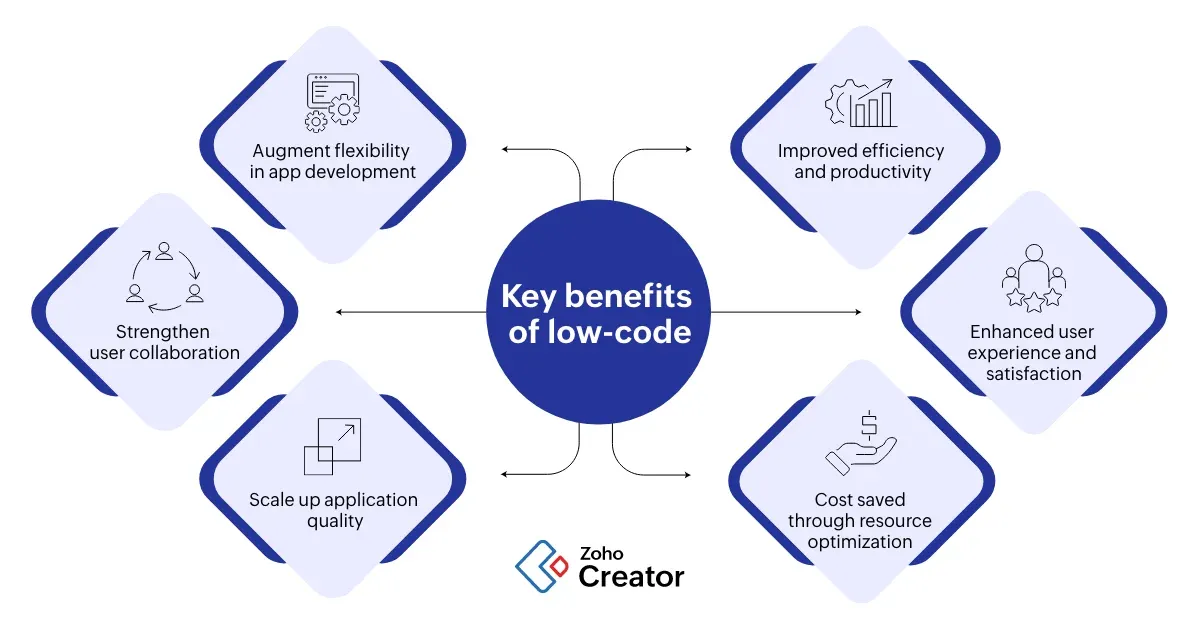
Apart from the exclusive visual interfaces, platforms entailing low-code development solutions incorporate features like drag-and-drop functionalities and built-in constituents that are known to ease up the entire procedure of app development.
The numerous features give one an upper hand and assist in designing, creating, and prototyping of the application. Enterprises no longer require extensive coding while working with an application. They don’t need extensive coding to get the procedure done. Therefore, the overall time required to lay down an application is much less on this platform in comparison to the other ones.
Low-code development solutions significantly help businesses by lowering the time-to-market for their applications and expanding their productivity at the same time.
This has been possible by the presence of built-in constituents and a visual development environment that facilitates developers to keep their focus on the logical and business aspects of the application rather than getting caught up in the intricacies of coding.
By doing this, the efficiency of development teams is boosted, motivating them to come up with high-quality applications in a shorter timeframe. As a result, companies can swiftly respond to market demands, launch new products or services, and gain a competitive edge.
Low-code app development platforms provide flexibility and scalability, allowing applications to adapt and scale as business requirements evolve. These platforms often offer built-in features for handling data storage, workflows, and integration with other systems.
This means that as an enterprise grows and its needs change, the low-code application can easily accommodate those changes without the need for significant redevelopment or extensive coding. This agility in application development enables organizations to quickly address new business challenges, seize opportunities, and stay ahead of the competition.
Low-code app development finds versatile use cases in enterprises. It can be utilized to build internal productivity apps that automate processes and improve collaboration, as well as customer-facing applications that enhance user experiences and engagement and more.
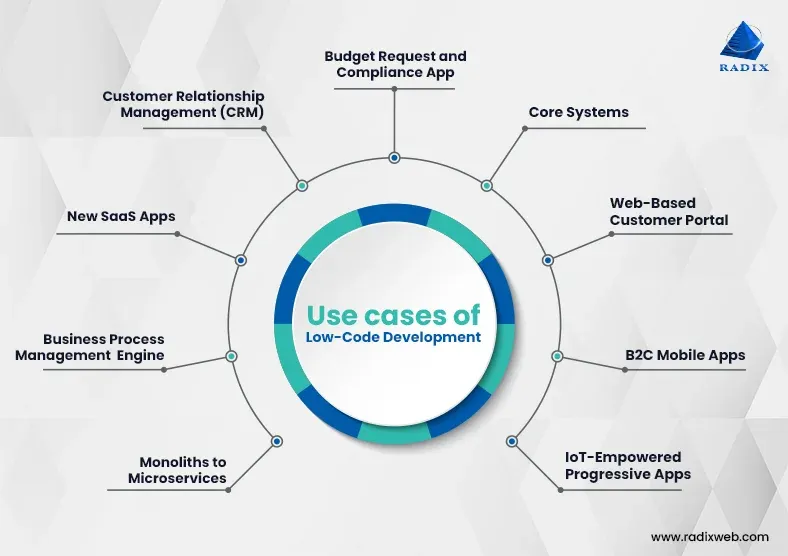
Enterprises can leverage low-code app development to build custom productivity applications that streamline and automate internal processes. These apps can range from simple task trackers and project management tools to more complex workflow automation systems.
By using low-code platforms, business users or citizen developers can design and develop these applications without extensive coding knowledge.
These productivity apps improve efficiency by automating manual tasks, reducing errors, and enhancing collaboration among team members. For example, a low-code app can be used to automate leave request processes, employee onboarding procedures, or inventory management systems, resulting in improved productivity and streamlined operations.
Low-code app development is also beneficial for creating customer-facing applications that deliver exceptional user experiences and engagement. Enterprises can quickly build and deploy mobile apps or web applications that cater to the specific needs and preferences of their customers.
Using low-code platforms, developers can easily incorporate features such as personalized content, interactive interfaces, and seamless integrations with backend systems. These applications can be used for activities such as e-commerce, customer self-service portals, appointment booking, or loyalty program management, enhancing customer satisfaction and loyalty.
Enterprises often face challenges when dealing with legacy systems that are outdated or difficult to maintain. Low-code app development provides an effective solution for modernizing these systems by integrating them with low-code platforms. This allows organizations to extend the functionality and lifespan of their existing systems without the need for a complete overhaul.
By integrating legacy systems with low-code platforms, enterprises can enhance their capabilities, improve user interfaces, and enable connectivity with other modern applications and services. This modernization approach helps organizations leverage their existing investments while transforming and future-proofing their technology landscape.
Suggested Reading:
The key features of enterprise-focused low-code platforms include visual development environments with drag-and-drop functionalities, integration capabilities with various data sources and APIs, and security measures to protect sensitive enterprise data. These features enable businesses to accelerate their app development process while keeping critical enterprise data secure and compliant.
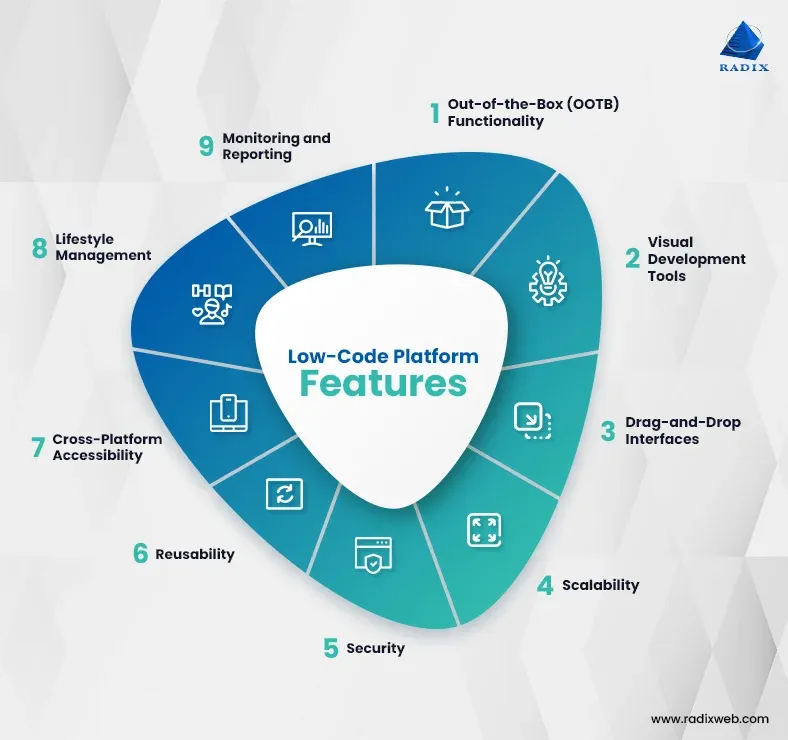
Enterprise-focused low-code platforms provide a visual development environment to simplify the application development process. The drag-and-drop functionalities offered by these platforms enable developers to design and build applications without having in-depth coding knowledge.
The use of intuitive visual elements and pre-built components allows developers to quickly prototype and iterate their applications. This speeds up the app development process, enabling businesses to reduce costs and bring their products to market faster.
An essential feature of enterprise-focused low-code platforms is their ability to integrate with various data sources and APIs. These platforms support integration with external systems and services, enabling users to assemble applications that can work with other platforms.
This allows enterprises to leverage their existing technology investments and adopt new technologies in a seamless manner. By extending app capabilities through integration, businesses can gain greater insight, operational efficiency, and drive productivity.
Enterprise-focused low-code platforms offer a range of security features to safeguard sensitive enterprise data. As data security is a critical concern for many businesses, these platforms offer several built-in features such as secure data storage, role-based access control, and encryption technologies.
These features ensure that applications are built using best security practices, reducing the risk of data breaches. Additionally, enterprise low-code platforms are compliant with industry regulations like HIPPA, SOC2, and GDPR, making them a safe choice for enterprises.
Suggested Reading:
Successful enterprise low-code app development requires following best practices to ensure efficient and effective outcomes. This section will explore three key best practices for enterprises embarking on low-code app development.
Before beginning the development process, it is crucial for enterprises to evaluate and select the right low-code platform that aligns with their specific requirements. Here are some factors to consider during the evaluation process:
By carefully evaluating and selecting the right low-code platform, enterprises can ensure they have the necessary tools and capabilities to successfully develop their desired applications.
Successful low-code app development involves collaboration between different stakeholders and end-users throughout the process. This collaborative approach helps in identifying requirements, improving user experience, and ensuring the app meets the desired objectives. Here's how enterprises can establish a collaborative development process:
By establishing a collaborative development process, enterprises can create apps that truly address the needs of all stakeholders and end-users, resulting in higher user adoption rates and overall satisfaction.
Suggested Reading:
To guarantee optimal performance and user satisfaction, enterprises must prioritize testing and quality assurance throughout the development process. Here are some best practices for testing low-code applications:
By implementing comprehensive testing and quality assurance procedures, enterprises can ensure their low-code applications deliver a reliable and user-friendly experience.
In conclusion, enterprise low-code app development is a powerful approach to create custom applications that enhances productivity and innovation while improving user experience.
The exclusive built-in features and visual interfaces are one of a kind and have the capacity to transform your business and give it a completely new edge.
It is extremely important for businesses to select the right low-code platform, establish a collaborative development process, and implement testing and quality assurance procedures to ensure optimal outcomes.
By leveraging these practices, enterprises can modernize their legacy systems, streamline their processes and workflows, and increase efficiency and productivity.
Overall, low-code app development offers a more efficient and cost-effective way for enterprises to develop custom applications and keep up with digital transformation. Businesses must explore low-code solutions and see how it can enhance their business processes and stay ahead in the rapidly changing technology landscape.
Now if you are looking for a highly customizable option for your mobile or web app development, then contact AppsRhino!
With over 300+ projects completed, 70+ top vetted developers, and a presence in 50+ countries, you can count on AppsRhino to deliver tailored solutions that exceed expectations.
Custom Development
7 Apr 2026
Tell us what your business actually runs on today, and we will map what it takes to make it one system.