

Custom Development
Alcohol Delivery Market Share and Trends: Size, Growth, & Business Opportunities
7 Apr 2026
Most people think Shopify is just a tool to build an online store.
But that’s like saying Apple just makes phones.
The Shopify business model goes far beyond website templates and checkout pages. It quietly powers millions of entrepreneurs, processes billions in transactions, finances growth, and earns from nearly every layer of the commerce journey.
What looks like a simple subscription platform is actually a tightly connected revenue engine built on software, payments, capital, and merchant services.
So, what is Shopify's business model really designed to do?
Let’s break down how Shopify makes money, explore its revenue streams, analyze its business model canvas, evaluate its subscription strategy, and understand its market position in 2026.
The business model of Shopify is a hybrid SaaS and transaction-based platform model that earns recurring subscription fees while monetizing merchant sales activity across its ecosystem.
In simple terms, Shopify provides the infrastructure to start and run an online business, then generates revenue as that business grows.
Here’s a clearer breakdown of the Shopify business model explained:
Merchants pay monthly or annual subscription fees to access Shopify’s commerce software and tools.
Shopify connects merchants, customers, app developers, payment providers, and logistics partners within one integrated platform.
Beyond subscriptions, Shopify earns from payment processing, POS systems, shipping services, capital financing, and app sales.
Instead of relying only on software fees, Shopify captures value at multiple touchpoints of the merchant journey.
This Shopify business model overview shows that it is not just a store builder, but a scalable commerce infrastructure company.

Understanding how Shopify makes money starts with understanding how its platform operates across the merchant lifecycle. Here’s how the mechanics work:
Entrepreneurs sign up, choose a plan, set up products, and launch stores through Shopify’s cloud dashboard. This is where Shopify merchant management begins.
Merchants select from Basic, Shopify, Advanced, or Plus plans. These recurring fees form the foundation of the Shopify revenue model.
Shopify hosts thousands of third-party apps and themes. Developers pay revenue share fees, creating an additional monetization layer.
Through Shopify Payments, the platform earns transaction fees on every sale.
This raises the common question: Is Shopify a merchant account? Not exactly. It partners with payment processors while offering an integrated payment infrastructure.
Shopify also earns from shipping, POS systems, capital financing, and other operational tools that help merchants scale.
So while subscriptions start the relationship, real growth in how Shopify makes money comes from merchant activity within its ecosystem.
Shopify earns revenue through two primary segments: Subscription Solutions and Merchant Solutions.
Let’s take a structured look at how each contributes to the Shopify revenue model in 2026.
This is the recurring SaaS layer of the business model of Shopify.
Subscription Solutions typically contribute approximately 23-25% of total revenue.
This section explains how Shopify’s growth accelerates as revenue increases alongside merchant sales and transaction activity. Let’s take a look.
*Revenue figures and pricing details are based on Shopify’s most recent official disclosures and may vary over time.*
Together, these revenue streams show how the Shopify revenue model scales with merchant growth, not just software subscriptions.
For businesses studying this structure, the real takeaway isn’t just understanding how Shopify makes money; it’s learning how to build platforms that align revenue with user success.
Teams like AppsRhino, which design scalable, transaction-driven mobile ecosystems, increasingly follow similar hybrid monetization principles when building commerce-first applications.
This canvas supports a deeper Shopify business model analysis and clarifies how Shopify makes money beyond subscriptions.
Let’s simplify it into one clear, structured snapshot.
This Shopify business model analysis shows it is not just a subscription SaaS company.
Key takeaway: Shopify’s competitive edge comes from aligning its revenue streams directly with merchant success, reinforcing its long-term market position.
If you evaluate the brand, an e-commerce software provider company, Shopify, on business plan & strategy, its strength lies in ecosystem monetization, where revenue scales with merchant growth and transaction volume.
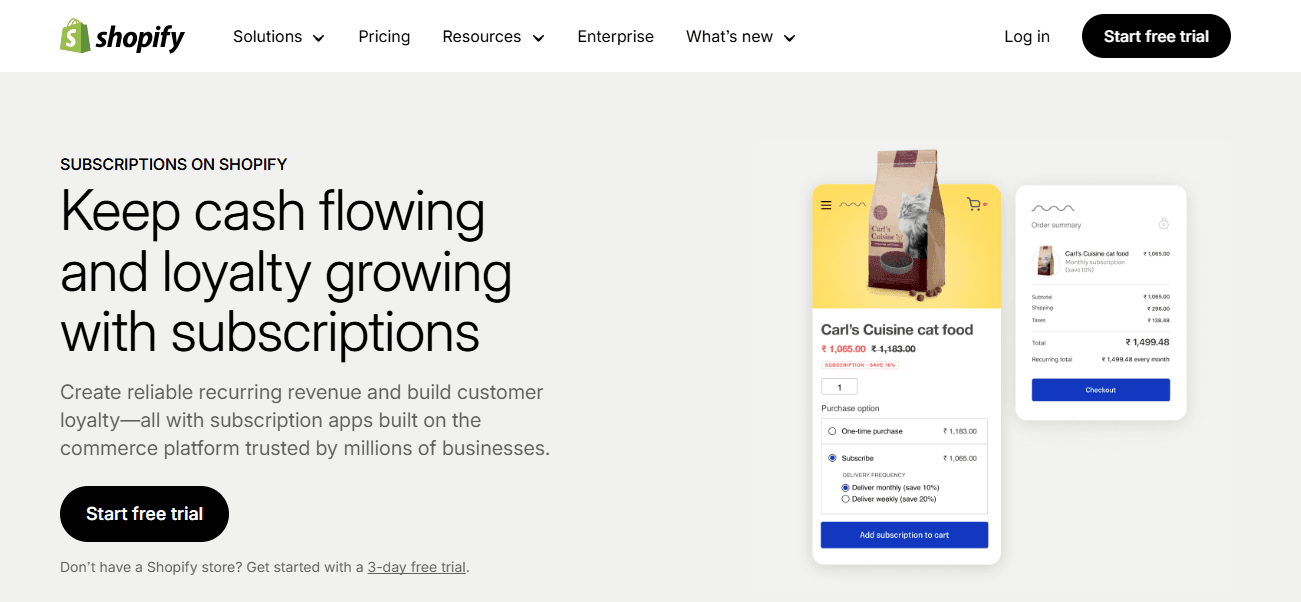
Is Shopify purely a subscription SaaS company? The answer is more layered than it appears.
Let’s find out below.
Evaluation: Sustainable, but not standalone.
The start-a-business Shopify subscription business model provides predictable recurring revenue, but long-term growth depends on merchant activity beyond the fixed monthly fees.
Evaluation: Strategically structured for expansion.
Merchants typically begin on lower tiers and upgrade as revenue grows, increasing average revenue per user without aggressive new customer acquisition.
Evaluation: High retention through ecosystem integration.
As merchants adopt payments, POS, shipping, and capital services, switching costs increase, reinforcing Shopify’s market position.
Evaluation: Core growth engine of the Shopify revenue model.
As gross merchandise volume rises, transaction-based earnings expand, proving that the Shopify business model and revenue streams scale with merchant success.
Overall Assessment: Shopify’s structural advantage comes from separating commerce infrastructure from marketplace ownership.
By enabling brand control while monetizing transaction flow, it secures long-term strategic leverage in the e-commerce industry.
Shopify isn’t just another commerce platform; it plays a very different strategic game. Let’s find out how it positions itself.
Amazon operates as a centralized marketplace. It owns traffic, controls visibility, and intermediates customer relationships.
The business model of Shopify is different. It provides infrastructure while merchants own their brand, pricing, and customer data.
That distinction is central to understanding what is Shopify business model is and why it appeals to independent brands.
Shopify’s competitive edge lies in its hybrid structure:
This layered structure strengthens the Shopify revenue model beyond basic software fees.
As merchants adopt Shopify Payments, Capital, POS, and third-party apps, operational dependence increases.
This ecosystem depth creates high switching costs and reinforces long-term retention.
From a strategic lens, the Shopify business model and market position sit between those of a SaaS provider and a commerce infrastructure leader.
From a strategic standpoint, Shopify strengthens its market position by combining predictable subscription income with transaction-driven scalability.
Unlike marketplaces, Shopify scales by empowering merchants rather than competing with them.
That positioning explains how Shopify revenue sources in the e-commerce industry continue expanding while preserving merchant autonomy.

Every business model has trade-offs. Let’s look at the pros and cons of the Shopify business model.
The Shopify advantages and disadvantages reveal a balanced structure: stable recurring revenue combined with growth tied directly to merchant performance.
This dual-layer approach explains how Shopify makes money while reinforcing its long-term market position in the e-commerce industry.
The business model of Shopify is strong, but it operates in a competitive and evolving environment. Here are the key challenges and how Shopify addresses them.
Competition from BigCommerce, Salesforce Commerce Cloud, and WooCommerce puts pressure on pricing and feature differentiation within the Shopify business model.
Solution: Shopify strengthens ecosystem depth, partner integrations, and enterprise tooling to maintain switching costs and brand loyalty.
A growing share of the Shopify revenue model comes from payments and merchant solutions, which carry thinner margins than pure SaaS.
Solution: Shopify improves operational efficiency and expands high-value services like Shopify Plus and automation tools to balance margins.
With payments and capital lending embedded, Shopify operates more closely with regulated financial infrastructure.
Solution: The company partners with regulated financial institutions and adapts compliance frameworks across global markets.
Because how Shopify makes money depends on GMV, economic slowdowns can directly impact transaction-based revenue streams.
Solution: Shopify diversifies revenue models through subscriptions, enterprise contracts, and global merchant expansion.
In the end, Shopify’s future isn’t just about growth, but also about how smartly it manages the risks that come with it.
Shopify’s next phase is being shaped by AI, embedded finance, B2B commerce, and deeper enterprise expansion.
With tools like Shopify Magic and Sidekick, AI is moving from experimentation to everyday merchant workflows, improving automation, content generation, and store optimization.
At the same time, Shopify continues to expand embedded finance through Capital, Balance, and credit products, strengthening how it makes money beyond subscriptions.
B2B commerce is another priority, with native wholesale features allowing merchants to manage DTC and bulk buyers in one system.
Combined with enterprise-focused upgrades in Shopify Plus, the business model of Shopify is evolving from a SaaS platform to a full-scale commerce infrastructure.
The business model of Shopify is more layered than it first appears. What looks like a simple subscription platform is actually a hybrid system that combines SaaS revenue, payments, capital, and merchant services into a single scalable engine.
If you’ve been asking what is Shopify business model is, or how Shopify makes money, the answer lies in alignment. Subscriptions bring merchants in, but transaction activity and ecosystem adoption drive expansion.
This structure explains Shopify’s market strength, its revenue streams in the e-commerce industry, and its long-term positioning.
This structure explains Shopify’s market strength and long-term positioning.
Businesses aiming to build similar hybrid, transaction-driven ecosystems often look toward execution partners like AppsRhino, which apply comparable monetization principles when developing scalable commerce platforms.
Custom Development
7 Apr 2026
Tell us what your business actually runs on today, and we will map what it takes to make it one system.